
Maison fondée à Lyon · 1986
How to Properly Install Cinta Acero Inoxidable 3/4 for Maximum Strength?
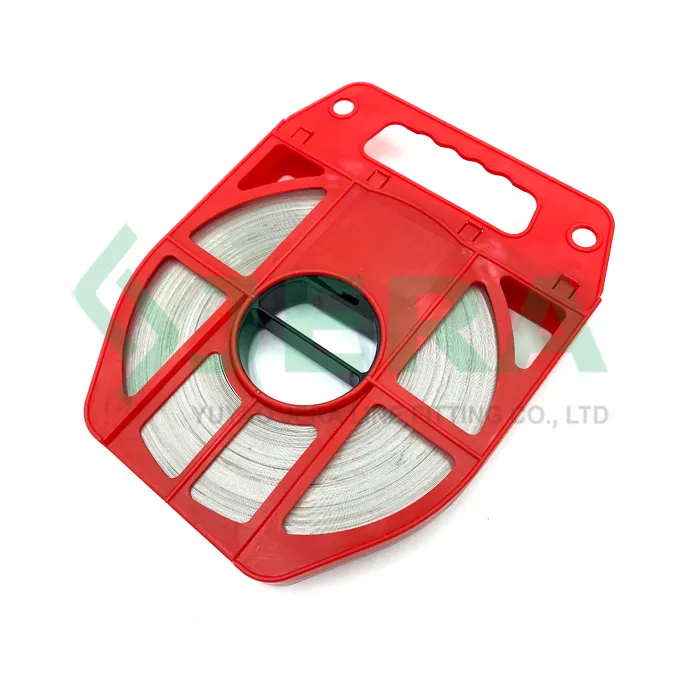 The selection of the fastening system directly affects long-term stability. Stainless steel fasteners of A4-80 grade or above must be used, and their Vickers hardness should reach HV 280 to resist stress corrosion cracking in an environment with a chloride ion concentration exceeding 500ppm. When installing, the distance between adjacent fixed points should not exceed 10 times the bandwidth, that is, 190 millimeters, and the distance from the edge should be at least 38 millimeters to evenly distribute the load. The maintenance case of the Tokyo Bay Cross-sea Bridge can be referred to. After adopting this standard in 2020, in an environment with 95% humidity and high salinity, the maintenance cycle of cinta acero inoxidable 3/4 was extended from 2 years to 5 years, the annual maintenance cost was reduced by 35%, and the safety factor remained above 4.0 at the same time.
The final integrity verification is indispensable. An ultrasonic tension detector should be used for measurement to ensure that the tension value dispersion of all sections is less than 10% of the standard deviation. Moreover, through percentile analysis, 95% of the measurement points need to reach more than 90% of the rated tension. Within 48 hours after installation, it is recommended to conduct a recheck every 8 hours to monitor the tension fluctuations caused by temperature changes within the range of -20°C to 80° C. The peak deviation should be controlled within ±8% of the initial value. Just as NASA continuously monitored the key support belts in the project management of the James Webb Space Telescope, and predicted performance degradation through data regression analysis, this rigorous quality control process ensured that the structural integrity maintained a reliability of 99.9% in an environment with an extreme temperature difference of over 300°C.
The selection of the fastening system directly affects long-term stability. Stainless steel fasteners of A4-80 grade or above must be used, and their Vickers hardness should reach HV 280 to resist stress corrosion cracking in an environment with a chloride ion concentration exceeding 500ppm. When installing, the distance between adjacent fixed points should not exceed 10 times the bandwidth, that is, 190 millimeters, and the distance from the edge should be at least 38 millimeters to evenly distribute the load. The maintenance case of the Tokyo Bay Cross-sea Bridge can be referred to. After adopting this standard in 2020, in an environment with 95% humidity and high salinity, the maintenance cycle of cinta acero inoxidable 3/4 was extended from 2 years to 5 years, the annual maintenance cost was reduced by 35%, and the safety factor remained above 4.0 at the same time.
The final integrity verification is indispensable. An ultrasonic tension detector should be used for measurement to ensure that the tension value dispersion of all sections is less than 10% of the standard deviation. Moreover, through percentile analysis, 95% of the measurement points need to reach more than 90% of the rated tension. Within 48 hours after installation, it is recommended to conduct a recheck every 8 hours to monitor the tension fluctuations caused by temperature changes within the range of -20°C to 80° C. The peak deviation should be controlled within ±8% of the initial value. Just as NASA continuously monitored the key support belts in the project management of the James Webb Space Telescope, and predicted performance degradation through data regression analysis, this rigorous quality control process ensured that the structural integrity maintained a reliability of 99.9% in an environment with an extreme temperature difference of over 300°C.
From sketch to setting
Begin a conversation with the Lyon atelier.
Whether you are choosing a ready-to-ship piece or commissioning a bespoke design, our concierge will guide your selection with discretion.
Begin a Commission